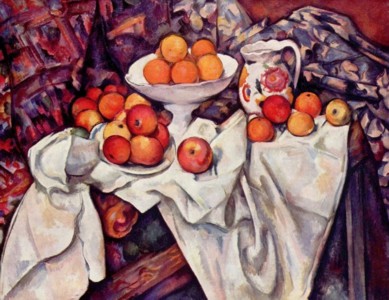
Paul Cézanne, Still Life with Apples and Oranges, 1895-1900
The consensus in the art books seems to be that Cézanne was the inspiration for Cubism. But in what way exactly? If one goes into the genesis of Cubism more deeply, to follow the trail back to Cézanne and lay it out in concrete terms, as I recently tried to do, the evidence turns out to be quite dubious. Or, one could start with Cézanne’s pictures and examine them for evidence of a connection going forward to Cubism, as I also recently tried to do. Again the evidence is dubious.
Apples and Oranges (above) is a case in point. Art historians point to it as an example of Cézanne’s supposed use of multiple viewpoints. “Multiple viewpoints” is seen as a founding principle of cubism. It’s claimed that in Apples and Oranges the table as a whole is seen from one viewpoint, while the tilted plate of apples (mid-left) is seen from another viewpoint, higher up. However, Cézanne was known to use things like wooden blocks and books to tilt objects upwards or forwards in his s
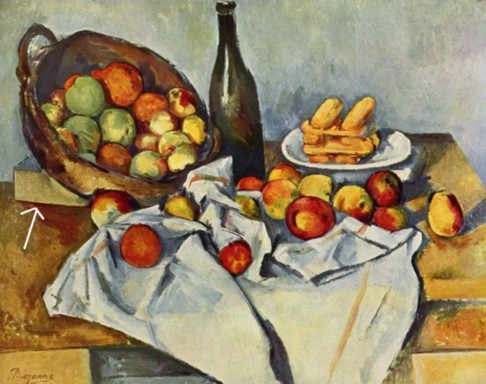 till lifes. Often the block would be hidden by a cloth, but sometimes it was visible (e.g., image at left, Still Life with Basket of Apples, 1890-94, arrow). Therefore it’s safer to assume that a tilted plate in a Cézanne still life is the result of being physically propped up rather than assuming a revolutionary change in the method of picture-making. A supporting block may be more mundane, but it’s more likely to be true.
Of course, if one now accepts the notion that the plate is physically tilted by a block placed underneath it, one might begin to wonder, why did he do that? That is another question altogether. I’d guess if one put one’s mind to it, a logical explanation would emerge, and in any case it’s not unusual for painters to use such devices in still life set-ups to get everything looking the way they want. But I do know that if the initial premise is wrong, the conclusion is likely to be wrong too, and I’m tending to feel that that is the case with the “multiple viewpoints” theory, both in Cézanne’s art and in Cubism.
Both images from Wikipedia
See also Cezanne 2: Multiple viewpoints and tablecloth

