Showing posts with label Cezanne. Show all posts

Tuesday, October 20, 2009

Level best

It might sound silly but one of the things I really like in drawings and paintings is when a level surface looks level. By this I mean, for example, that because of good drawing, a drawn or painted tabletop can be seen to be level. The edges might be slanted because of perspective but we as ordinary viewers know if it's "right". This preference goes against the grain of Modernism which delighted in throwing conventional perspective out the window and which teems with "tipped up" tabletops and other such surfaces. I like these too but don't feel authentic doing it myself and besides Modernism is long gone.

I sometimes use a little test of my own to figure out if something in a drawing is level. For instance, take the chair seat in Vermeer's "Woman Reading a Letter", and try this to check if it's really level: imagine placing a marble in the centre of the seat and then feel it with your body. Will the marble stay put or will it roll off?

The thing about tipped-up tabletops in Modernism is interesting for another reason. The trend developed from a belief that Cézanne's tipped up still life paintings were a manifestation of the use of multiple viewpoints and were therefore a precursor to Cubism. In previous posts I have ventured some evidence against this view. I'm now reading a book about Cézanne's landscapes that tends to question some of the 20th century art theory that was built on the tipped-up assumptions. Very interesting indeed, more in another post.

Wednesday, December 20, 2006

Cezanne: That Pedestal

This drawing happened the wrong way round. I was looking at a Cézanne still life and scribbled this diagram of the composition onto the back of an envelope. A few weeks later the diagram, lying on the desk, floated into consciousness. And all of a sudden, there it was: the reason for Cézanne‘s off-centre pedestal. It had to be off-centre or else he’d have had to repaint the fruit entirely, moving the main weight to the right. Instead he moved the pedestal to the left, under the centre of gravity. This was a kind of eureka moment for me, and I pass it on as a Christmas present to my (rare and much appreciated) readers.

Much has been written about Cézanne‘s composition, which somehow works in spite of oddities like this. Or rather, this way of looking at it helps to explain why his composition works so well. In this case, I'm proposing that the off-centre pedestal was not random or arbitrary, and that it was not a vague device “to strengthen the composition”; and further, that Cézanne was not consciously inventing a revolutionary school of painting. Rather, I'm saying that he moved the pedestal because everything on earth is subject to the law of gravity, and it suited his pictorial purpose better to move the pedestal rather than to move the fruit.

This completes the thought about Cézanne‘s pedestal which was originally mentioned in a discussion about the artist's intention.

(Edited Jan 10, 2007 -- rephrased and cut but the meaning not changed)

.

Friday, November 10, 2006

Cezanne 2: Multiple viewpoints and tablecloth

In Cézanne’s famous Still lIfe with Apples and Oranges, it has been claimed that the table is being shown from two viewpoints, and in fact the lower left part of the picture is very confusing. One oft-quoted theory is that the leg of the table is resting on a sofa. What is going on?

Specific, answerable questions arise:
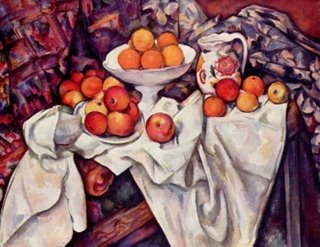

1) The table itself, is it parallel to the viewer (horizontal) or is it at an angle going into the picture, or both?

2) That round yellowish thing in the lower left quadrant, is it a drawer knob? Probably not, because it’s too big. So what could it be?

After much pondering, I began to wonder if the lower left part of the painting could be explained by an additional tablecloth with a border and a big pattern. This would mean there are three different fabrics in the painting in addition to the white tablecloth: two in the background, a red and green one on the left, and a beige and green one on the right, and then, underneath the white cloth, another tablecloth with a big pattern and a border, placed on the table at an angle so that you’re seeing the border as a diagonal in the lower left of the painting.

Seen in this way, the table could be straight on to the viewer, with the proposed new tablecloth draping over the corner of the table at far right. A Google image search shows that in the majority of Cézanne’s still lifes the table is in fact horizontal ; and the renowned critic Meyer Schapiro has said that the mass of the the objects in this still life is more or less horizontal across the picture plane. But these two things alone don't prove anything. More convincing evidence could come from another quarter: As a painter of still life myself, I’m conscious of how studio props may be used by painters over and over again in different combinations, so much so that you can sometimes identify the painter by the props. So, to find supporting evidence for my hypothesis, I set out in search of another Cézanne still life with the proposed new tablecloth in it. This was the mission: to find a still life by Cézanne containing a fabric with a large pattern and a border.
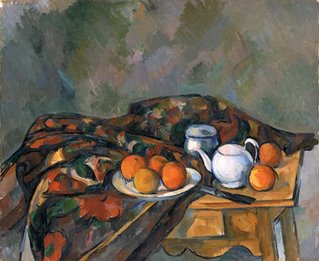
To my amazement, I actually did find one, obscure as it may be, on the website of the National Gallery of Wales. It's called Still Life with Teapot (1902-06, left), and the big pattern and border of the fabric are consistent with the proposed new cloth. The bordered edge is even draped diagonally over the table edge. The colours are not identical, but this is not significant, because the purpose of still life painting is not necessarily to copy the objects.

And as if that was not enough, earlier this year I had further confirmation that the hypothetical tablecloth really did exist in Cézanne’s studio. I came upon it, amazing as it may seem, in the Museum of Modern Art in New York: another Cézanne still life with the hypothetical cloth, called Still Life with Ginger Jar, Sugar Bowl and Oranges, 1902-06.

(Above: My blurred photo of the Moma still life)

So now I am reasonably sure that this is a valid explanation of this particular aspect of Apples and Oranges, or rather its lower left quadrant. It was a fun project, a little like detective work, and I was thrilled to come up with a plausible alternative to existing theories. But it has left me feeling sceptical about academic readings of paintings and still unconvinced about the role of multiple viewpoints in Cézanne's art; which in turn makes Cézanne's role in Cubism less clear.

(See also Cezanne 1: Multiple viewpoints and Cubism)

Monday, September 25, 2006

Hands

(Click on the image to see it bigger)

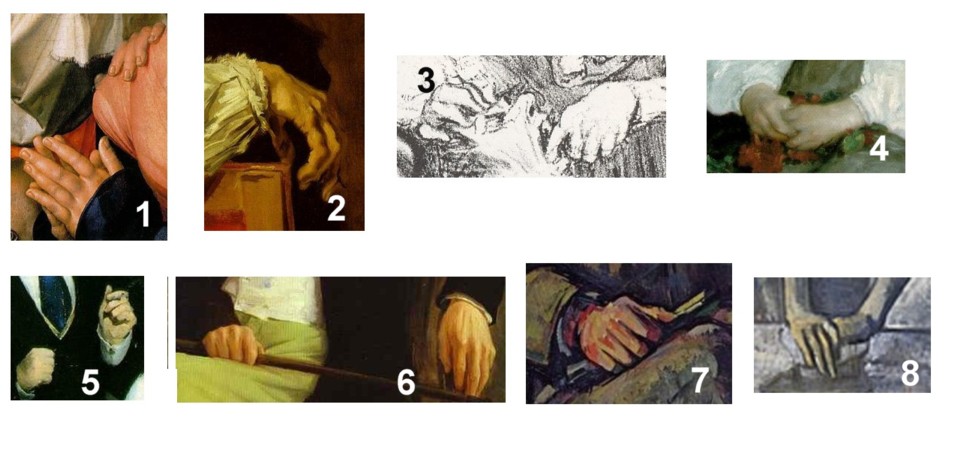
Here is a montage of hands by master artists, but which artists? Is it possible to tell the artist from just one little part of a picture?

Hands are considered to be difficult things to draw and paint. Artists often avoid them, using a variety of devices to keep them out of the picture. However, if the artist has the skill, hands can express character and mood to an amazing extent, as the montage shows. Here are some labels to describe the way I read the types, mixed up, not in the numbered order:

  • No-nonsense hand
  • Shy hands
  • Earnest hands
  • These hands mean business
  • Man-about-town hands
  • Expressive hands
  • Debonair hand
  • Decisive hands

Click here for the artists who painted them and the way I read the types. The pictures are bigger too.