Showing posts with label Picasso. Show all posts

Tuesday, January 26, 2010

Picasso's landscapes


Picasso isn't well known for his landscapes so I was surprised recently to find them a treasure trove for the art student. A striking feature (to me, anyway) is that, despite his reputation as an "abstract" artist, his landscapes have a definite sense of place, more so than many photorealist-type landscape paintings. If you're a Picasso fan this isn't surprising because as we know he aimed to intensify experience by distortion, emphasis, even caricature. So the Mediterranean landscape above is vintage Picasso and also intensely Mediterranean, from the rooftops shimmering in the sun and the deep blue sea down to the triangles of terraced garden and the potted plant on the wall. Another one is of a village called Mougins where he lived for the last fifteen years of his life. It shows a mountain landscape with lakes and tilled fields, with the muted colour conveying a sense of awe at the majesty of nature.

This is something I'd like to be better at, expressing a sense of place in landscape painting.

It's interesting too that these pictures show Picasso's mastery of and interest in depth, debunking the received wisdom that he was a flat painter (Greenberg I think, and others, can find a ref. if anyone wants it).

[Countdown: Empty pages remaining in main sketchbook = 37]

Sunday, August 10, 2008

Some drawing criteria

Mademoiselle Lacaux, by Auguste Renoir

I've always thought that Renoir was a brilliant draftsman and that everyone else would think so too. But it's by no means a universal view, and in the end it's a matter of taste and how different people define drawing. In fact there's no universally accepted definition of drawing, and it's futile to devote too much time to thinking about it.

However, it's important to me personally to have my own understanding of what drawing is, and especially what good drawing is, because otherwise how do I know what I'm striving for, and whether or not I've achieved it?

These are the criteria I use to judge drawings, my own and others:

Unity. Everything in nature has intrinsic unity. If the unity is disrupted or broken the object ceases to have life or to be itself, or the drawing is not convincing. Unity in a drawing is easiest to see in figure drawings, especially hands, and in animal drawings; but there's unity in everything, including landscapes and man-made objects. For an example of a lack of unity, imagine a drawing of a flower pot that looks as if it's made of plasticene.

Balance. I've blogged about balance in drawing before (A sense of balance). The kind of balance I mean relates to the law of gravity and it can be sensed or felt with one's own body rather than seen. A lack of balance in a drawn or painted figure or object is to me a fatal flaw, especially if it's my own drawing, unless there's a compelling reason for it to be like that.

Three dimensional form. A drawing that gives a solid illusion of three dimensions on a flat surface is a beautiful thing to see. Dark and light tones (or "shading") can help to achieve it, but there's more to it than that because a seemingly flat silhouette, or a simple contour, can give a convincing sense of three dimensional form with no shading at all. What it means is that drawing is a more complex and mysterious skill than at first it seems.

Life. Achieving a feeling of life is tied up with unity, balance and three dimensions. There's a magical quality about a sense of life in a drawing or painting, and if the work has life, then other shortcomings might be overlooked.

Renoir's painting of Mlle. Lacaux has all these qualities -- unity, balance, three dimensions and life, satisfying all my criteria. I wish I could draw like that.

Oddly enough, Picasso's sketchbook drawings of invented "creatures" (links below*) satisfy all my criteria too. The fact that they have 'life" is especially remarkable because these particular drawings are of invented inanimate clunky objects which could be carved from wood or plaster.


Some of Picasso's invented forms from 1927:
(first link, bottom of page; second link, top of page)
http://picasso.csdl.tamu.edu/picasso/WorksIndex?Year=1927&ViewStyle=gallery&CurrentItem=31

http://picasso.csdl.tamu.edu/picasso/WorksIndex?Year=1927&ViewStyle=gallery&CurrentItem=61

Some of Picasso's invented forms from 1933 (titled "An Anatomy")(first link, bottom of page; second link, top of page)

http://picasso.csdl.tamu.edu/picasso/WorksIndex?Year=1933&ViewStyle=gallery&CurrentItem=31

http://picasso.csdl.tamu.edu/picasso/WorksIndex?Year=1933&ViewStyle=gallery&CurrentItem=61


*Edited 17 June 2013: Those links were to The Online Picasso Project website which sad to say has since been closed to the public. Neither can I find those images anywhere else. It may be worth tracking down a copy of the big book by Carsten-Peter Warncke and Ingo Walther titled "Picasso" which has more than 700 well illustrated pages. I don't think the sketches referred to above are in it but there's a chapter in the middle called "A Juggler of Form", starting page 305, which has a variety of his other inventions.


Saturday, July 5, 2008

Picasso's way of working


In The Family of Saltimbanques Picasso achieved a universal quality, mysterious and poignant, that lifts it out of the realm of ordinary genre. His studies for the painting show how he worked, with numerous studies of variations of the group and of the individual figures. Many of them are available at the click of a mouse in the Online Picasso Project (list of links below).

[Edited 17 June 2013: Unfortunately the Online Picasso Project has since been closed to the public.]

It could have been a sketchbook drawing at the races that inspired the picture. The first compositional study shows the main grouping, without the woman at lower right, with horse-racing in the background. In the final painting the background is plain and featureless; just barren earth and sky, similar to the "Boy with a Horse".

Seeing Picasso's approach is nothing short of inspiring. It's an encouragement to stop labouring over a study that's going nowhere and instead to do another, and another and another.

And too, as an OCA student, it validates the OCA's teaching methods. You have to do "studies" from the first project in the first painting course. At the beginning I found it irritating -- why do yet another charcoal drawing when I already have a perfectly good one? But over time it has become second nature and, although I'll never be another Picasso (sad to say), I'm attempting things I would never have done before and I can see the value of all the drill.

Links to the Online Picasso Project: Click on the picture to see a bigger version. Also, you will surely find more sketches and studies by looking through the catalogue for 1905.
Boy Leading a Horse
http://picasso.csdl.tamu.edu/picasso/WorksInfo?CatID=OPP.06:012

1905

Acrobat and Young Harlequin
http://picasso.csdl.tamu.edu/picasso/WorksInfo?CatID=OPP.05:004

Boy with Dog
http://picasso.csdl.tamu.edu/picasso/WorksInfo?CatID=OPP.05:016
Two Acrobats with Dog
http://picasso.csdl.tamu.edu/picasso/WorksInfo?CatID=OPP.05:017
Bouffon with Young Acrobat
http://picasso.csdl.tamu.edu/picasso/WorksInfo?CatID=OPP.05:010
Study for Saltimbanques
http://picasso.csdl.tamu.edu/picasso/WorksInfo?CatID=OPP.05:014
A sketchbook study for the Saltimbanques
http://picasso.csdl.tamu.edu/picasso/WorksInfo?CatID=OPP.05:110

Gros Buffon Assis
http://picasso.csdl.tamu.edu/picasso/WorksInfo?CatID=OPP.05:034
Young Girl with Dog
http://picasso.csdl.tamu.edu/picasso/WorksInfo?CatID=OPP.05:272
Mallorquine
http://picasso.csdl.tamu.edu/picasso/WorksInfo?CatID=OPP.05:005

The Family of Saltimbanques
http://picasso.csdl.tamu.edu/picasso/WorksInfo?CatID=OPP.05:002

Saturday, May 5, 2007

Cubism essay, update

I have now put the Cubism essay of the previous post into html which is much easier to access, approx. 50K vs. 1.6 MB, and I've removed the PDF file. The html file is at http://maryadamart.com/Cubism_The_Big_Picture.htm

Friday, May 4, 2007

Cubism, the Big Picture

I've put a PDF file on my website called "Cubism: The Big Picture", here. It's an essay I wrote last year on the origins of Cubism and its logic and rationale, focussing mainly on Picasso. It's just over 2000 words, about 10 pages. I will do it in html eventually, don't have time right now. The conclusion I came to was not what I've seen in standard sources such as Gombrich. Unfortunately I had to take out most of the images and put links instead. Comments would be great... and please do email me at folio@wow.net if the file gives any trouble to download or to open.

Monday, September 25, 2006

Hands

(Click on the image to see it bigger)

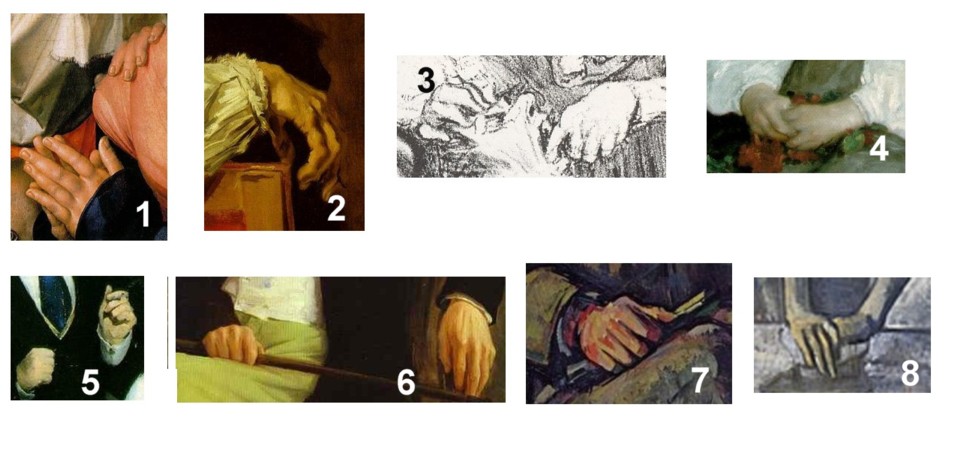
Here is a montage of hands by master artists, but which artists? Is it possible to tell the artist from just one little part of a picture?

Hands are considered to be difficult things to draw and paint. Artists often avoid them, using a variety of devices to keep them out of the picture. However, if the artist has the skill, hands can express character and mood to an amazing extent, as the montage shows. Here are some labels to describe the way I read the types, mixed up, not in the numbered order:

  • No-nonsense hand
  • Shy hands
  • Earnest hands
  • These hands mean business
  • Man-about-town hands
  • Expressive hands
  • Debonair hand
  • Decisive hands

Click here for the artists who painted them and the way I read the types. The pictures are bigger too.