Announcing a 3-day Collage Workshop
http://artclassesonline.blogspot.com/2012/08/collage-workshop.html
Friday, August 17, 2012


Saturday, August 4, 2012
From Paul Klee's diaries
 |
| Paul Klee 1911. Photo by Alexander Eliasberg from Wikipedia. |
June 1903 [...] "Toward the end of the month I prepared engravings; first, invented appropriate drawings. Not that I want to become a specialist now. But painting with its failures cries out for the relief of minor successes. Nowadays I am a very tired painter, but my skill as a draftsman holds up."
From The Diaries of Paul Klee
Black Columns in a Landscape 1919 at the Metropolitan Museum of Art, New York.
Sunday, June 24, 2012

Wednesday, May 30, 2012
Trees and foliage
Two logbook pages from March 2010. These are about Van Gogh's trees and the marks he used to show the foliage.


Right-click and "open link in new window" to enlarge.


Right-click and "open link in new window" to enlarge.
Sunday, April 15, 2012
A logbook page from 2009
 |
| Page 28 |
Sunday, March 11, 2012
Pakchoi screenprint
 |
| Mary Adam, Pakchoi, screenprint on 9 x 12" paper |
 |
| New wooden screen attached to desk with hinge clamps |
Tuesday, February 28, 2012
Maracas
 |
| Mary Adam, Maracas Bay, graphite, 9 x 12" |
A drawing from a photo of the sea at Maracas after an ASTT plein air session on a recent Saturday, 9 x 12" sketchbook. The one below was done while there on the day in a small sketchbook. It was very fascinating to sit there in a small patch of shade contemplating the endless movement of the sea.
 |
| Mary Adam, Maracas, gouache, approx 5 x 8" |
[Edited 22/3/2012, photo of Maracas drawing replaced]
Friday, February 3, 2012
Set-up for printing a collagraph

Clockwise from top right:
Inks -- several tubes of ink in different colours.
Glass plate for mixing and rolling inks.
The collagraph block -- various things glued to a piece of cardboard. Ink will be rolled over it while it's on the newspaper, then it will be moved to the printing area.
A board -- this is an old canvas board that I use for printing. It has registration strips or guides securely glued on. When ready to print I put a sheet of the printing paper up against the strips and then glue it to the board. Then I center the printing block on the paper and mark the outline in pencil. This helps to get the block in the right place after each inking.
A baren -- for pressing on the back of the paper to transfer the ink from the block.
Brayers (2) -- small rubber rollers for rolling out the ink and inking the block.
Friday, January 27, 2012
Which is your family of painters?
From an oral history interview with Robert Motherwell (1915--1991):
PAUL CUMMINGS: You've mentioned before something about visiting the Stein collection and how that happened in Palo Alto. Had you seen many paintings before that in going to museums out there?
ROBERT MOTHERWELL: I used to collect books, little Italian books of all the old masters. I really learned to draw copying Michelangelo and Rembrandt and Rubens' Baroque paintings. But I didn't know modern art existed except from some Cézannes that I had come across in the Encyclopedia Britannica, which I also copied. You see, I was only seventeen when I saw the Matissess and they were literally the first twentieth-century pictures I ever saw. And I fell for them at first glance, and to this day au fond Matisse moves me more than any other twentieth-century painter. But I also think there are families of painting minds quite apart from history; that there are about -- I don't know -- five or six basic psychological types; and that whatever the type is that Matisse is, I think that is the family that I naturally belong to.
PAUL CUMMINGS: How would you describe those? What is an example of a family?
ROBERT MOTHERWELL: For example, Vermeer is the family I feel the most alien to. Several years ago in a very learned article in the College of Art Bulletin I was very pleased to discover that he used a machine -- the camera obscura. And I would say that, say Norman Rockwell, and Wyeth, and all kinds of people belong to that objective eye who love to work with photographs or machines and look at everything in a very retinal lens-like way. There's another family like the Caravaggios and the Spaniards -- Murillo and so on, and one aspect of Rembrandt that loves dramatic contrasts of light and dark and blackness and so. And there's certainly a linear type like the ancient Greeks and the Siennese and the Florentines. And there's another kind that's very sensual, that if you look at the picture from a distance it's very beautiful in its way and if you look at the surface very closely, you know, your eye just two or three inches away and just looking at a square inch or two it's intrinsically beautiful just as a painted surface, the way when you's having a beautiful meal if you look at the food, you know, you're sitting at the table and you're looking at the plate there's something marvelous about all the textures and colors and so on. And I think Matisses are par excellence that kind. And it's that kind I like. and Rembrandt has it. Titian has it. Most classical twentieth-century painting has it. The Impressionist had it, although the Impressionists are less clear-cut in their shapes than I like.
Oral history interview with Robert Motherwell, 1971 Nov. 24-1974 May 1, Archives of American Art, Smithsonian Institution
http://www.aaa.si.edu/collections/interviews/oral-history-interview-robert-motherwell-13286
PAUL CUMMINGS: You've mentioned before something about visiting the Stein collection and how that happened in Palo Alto. Had you seen many paintings before that in going to museums out there?
ROBERT MOTHERWELL: I used to collect books, little Italian books of all the old masters. I really learned to draw copying Michelangelo and Rembrandt and Rubens' Baroque paintings. But I didn't know modern art existed except from some Cézannes that I had come across in the Encyclopedia Britannica, which I also copied. You see, I was only seventeen when I saw the Matissess and they were literally the first twentieth-century pictures I ever saw. And I fell for them at first glance, and to this day au fond Matisse moves me more than any other twentieth-century painter. But I also think there are families of painting minds quite apart from history; that there are about -- I don't know -- five or six basic psychological types; and that whatever the type is that Matisse is, I think that is the family that I naturally belong to.
PAUL CUMMINGS: How would you describe those? What is an example of a family?
ROBERT MOTHERWELL: For example, Vermeer is the family I feel the most alien to. Several years ago in a very learned article in the College of Art Bulletin I was very pleased to discover that he used a machine -- the camera obscura. And I would say that, say Norman Rockwell, and Wyeth, and all kinds of people belong to that objective eye who love to work with photographs or machines and look at everything in a very retinal lens-like way. There's another family like the Caravaggios and the Spaniards -- Murillo and so on, and one aspect of Rembrandt that loves dramatic contrasts of light and dark and blackness and so. And there's certainly a linear type like the ancient Greeks and the Siennese and the Florentines. And there's another kind that's very sensual, that if you look at the picture from a distance it's very beautiful in its way and if you look at the surface very closely, you know, your eye just two or three inches away and just looking at a square inch or two it's intrinsically beautiful just as a painted surface, the way when you's having a beautiful meal if you look at the food, you know, you're sitting at the table and you're looking at the plate there's something marvelous about all the textures and colors and so on. And I think Matisses are par excellence that kind. And it's that kind I like. and Rembrandt has it. Titian has it. Most classical twentieth-century painting has it. The Impressionist had it, although the Impressionists are less clear-cut in their shapes than I like.
Oral history interview with Robert Motherwell, 1971 Nov. 24-1974 May 1, Archives of American Art, Smithsonian Institution
http://www.aaa.si.edu/collections/interviews/oral-history-interview-robert-motherwell-13286
Thursday, January 12, 2012
Tuesday, December 27, 2011
Year-end figures
Subscribers (email and RSS) = 113 (last year = 95)
Total page views for the year = 15,096 (last year = 15,933)
Posts for 2011 = 34 (last year = 34)
Exhibitions: After five years of not exhibiting because of studying for a degree, this year I've had new work in five group shows from April onwards (the National Museum show from April to June, Women in Art annual exhibition in October-November, The Art Society of Trinidad and Tobago annual exhibition November-December, Y Art Gallery Christmas show, and Soft Box Studios End of Year show), altogether about 12 pieces.
Yet another blog: I've started a new blog linked to my art classes website. It's mainly for announcements of upcoming workshops, additions to the website, new videos if any, etc. Partly so as not to clutter Drawing etc with things for which it wasn't intended.
 |
| Some of this year's work |
28.12.2011: Post was edited to correct dates of exhibitions.
Sunday, December 18, 2011
JSTOR early content
Just stumbled on this a while ago: JSTOR has made some of its content available free to the world at large. The relevant content is pre-1923 in the USA and pre-1870 in the rest of the world. I've had a peek, will have to go back when there's time. It could be useful for projects with a historical element or slant.
http://www.jstor.org
http://www.jstor.org/action/showAdvancedSearch?ModifySearch=Modify+Search&wc=off&acc=on
http://www.jstor.org
http://www.jstor.org/action/showAdvancedSearch?ModifySearch=Modify+Search&wc=off&acc=on
Saturday, November 12, 2011
Christmas cards
 |
| Mary Adam, three cards from an edition of nineteen |
Wednesday, October 19, 2011
Sketchbook website
"It takes me a long time to fill up a sketchbook, but when I do it’s so satisfying. They are my diaries, and when I look at old pages I can remember exactly what I was doing and feeling, even though there is no extensive writing."
http://www.book-by-its-cover.com/sketchbooks/sketchbook-series-becca-stadtlander
Friday, October 14, 2011

Saturday, October 8, 2011
A work in progress
 |
| Flower piece |
Monday, August 29, 2011
Looking back and looking forward
 |
| Mary Adam, Savannah Rain study, A4 |
Looking back over the last few months I've been doing too much, if that's possible, and yet not achieving enough. The degree result came on April 12. Since then I've made a couple of complex prints plus a whole lot of small experimental prints; researched and written a paper on the length of the OCA painting courses; filled well over a hundred sketchbook pages; made a couple of short videos as preparation for online art teaching (if anyone happens to find them, please give them a thumbs up if you like them); painted a number of small still lifes, some of which are junk and some I'm pleased with; had a linocut accepted by the National Museum for the "Women and Art" exhibition (proud of that, it's in the catalogue); had a couple of personal setbacks; finished, sent and got back the third assignment for Printmaking 1 with great tutor feedback; and started two new websites. Now it's time to take stock and get some idea where I'm heading. Not to beat around the bush, this blog might go quiet for a while. But probably not for long, I just need some time to think. Not complaining, it's an ok place to be.
Thursday, August 18, 2011
Gummed paper tape 2

The screen with the new fabric and gummed paper tape. This will be followed by two coats of urethane varnish over the tape and about 5 mm of screen. A heavier weight of paper would have been better but this is doing the job well enough for now. Will try cartridge paper next time.
Friday, August 12, 2011
Testing the gummed paper tape
 |
| Brown paper with a thin coating of gum arabic. |
Luckily screens don't need new fabric often. The small screen has held up well for about three years, through countless washings, often with chemicals such as bleach. Now it has a haze of ghost images and the gummed tape is breaking up. The tape on that occasion came from a roll which was new at the time but which has since become stuck together because of humidity. So that idea about making my own gummed tape in small amounts as needed now comes into play.
For this job the tape has to stick well to the wood and the screen fabric, I want it to last for a couple of years. The idea is to seal the join between the fabric and the wood so that ink can be cleaned out of the screen thoroughly after use.
The brown paper that I have is rather thin but I tried it anyway. The first try didn't go too well. I applied a single coat of gum arabic with an ordinary soft bristle brush, about a No. 8. Afterwards I realised the gum was thick in places. Went ahead today and cut it into two-inch strips, moistened them with a wad of damp kitchen paper, and stuck them onto the inside of the frame and about 3/4" onto the fabric. The tape stuck in some places and came away in others, which isn't good enough, so I pulled it all off.
I used the same tape to stick a piece of watercolour paper to plywood and that was fine, it stayed firm.
I made a second set of tape, applying a second thin coat when the first was dry instead of just one coat. I then cut the paper into strips as before, moistened it and applied it to the screen. This appears to have stuck properly. When the tape is fully dry tomorrow I will varnish the whole frame and it should be good for another couple of years.
--------------
*** EDIT, added March 11, 2012: Wooden frames for screen-printing are in fact still being made, see http://mary-adam.blogspot.com/2012/03/pakchoi-screenprint.html
Friday, July 22, 2011
Tree, Chaguaramas 5
 | |
| Mary Adam, Tree, Chaguaramas |
Enlightenment
It's such a wrench to sell books but it must be done, Having a quick re-read of some sold books before they go on their way, this passage from Immanuel Kant (1724--1804) strikes me as fresh and direct and relevant -- must be something wrong with me.
"Enlightenment is man's release from his self-incurred tutelage. Tutelage is man's inability to make use of his understanding without direction from another. Self-incurred is this tutelage when its cause lies not in lack of reason but in lack of resolution and courage to use it without direction from another."(In The Art of Art History: A Critical Anthology, ed. Donald Preziosi, 1998, OUP).
Wednesday, July 13, 2011
Plate drawing
 |
| Mary Adam, Bread and plate, coloured pencil |
The reason for doing this was to keep on drawing and to make the plate sit down flat on the cloth, so it's not very exciting. I used coloured pencils, my least favourite medium. I don't have a big selection, just a box of twelve from the supermarket and a set of five from the art shop that I've had for ages. Even with that I used very few colours, maybe five or six overall. The main place I couldn't get the colour right was the inside of the bread. I'm definitely not a colour pencil-ist but they're nice to have, it's a different kind of experience, slow and measured. I was surprised to find that they can be erased as long as the mark doesn't make a dent in the paper.
Sunday, July 3, 2011
Art books for sale 1

Frameworks for Modern Art, ed. Jason Gaiger, 2003, Yale Univ Press in association with the Open University. ISBN 0300102283 Paperback, good condition -- US$ 12.00 SOLD
The Shock of the New, Robert Hughes, Alfred A Knopf, New York, 2002. Paperback, good condition. ISBN 0679 728767. US$ 12.00
Keys to Drawing, Bert Dodson. North Light Books. ISBN 0891 343377. Paperback, good condition. US$ 10.00
Drawing Essentials, Deborah Rockman. Oxford University Press, 2009. ISBN 9780 195314328. Paperback, good condition. US $ 10.00
A Foundation Course in Drawing, Peter Stanyer & Terry Rosenberg. Watson-Guptill, New York, 2003. ISBN 08230 18687. Paperback, good condition. US$ 10.00
Complete art foundation course, Drawing, watercolour, oils and acrylics, Curtis Tappenden, Anna Taylor, Paul Thomas, Nick Tidnam. 2006, Cassell Illustrated. ISBN 1-84403-4879. Hardcover, like new. US $ 12.00
Collins Artist's Manual, ed. Angela Gair. 1995. HarperCollins Publishers. "The complete guide to painting and drawing materials and their use". ISBN 13: 9780 00 4133638. Paperback, like new. US $ 10.00
Experimental Drawing, Robert Kaupelis, 1992. Watson-Guptill Publications, New York. ISBN 08230-16226. Paperback, fair condition, US$ 10.00
Clement Greenberg, Art and Culture: Critical Essays, 1961. Beacon Press, Boston. ISBN 08070 66818 paperback. Very good condition, includes “Avant Garde and Kitsch”. US$ 12.00; weight: 0.5 Kg, 1 lb. SOLD
Clement Greenberg, The Collected Essays & Criticism, Vol. 2, Arrogant Purpose, 1945-1949: ed. John O’Brian. The University of Chicago Press. ISBN 0226306224, paperback. Good condition. US $ 14.00; Wt >1 lb, .5 kg. SOLD
Malcolm Andrews, Landscape and Western Art, 1999, Oxford University Press. ISBN 9780 192842336, paperback, used, good condition. US $ 12.00.
David Sylvester, Interviews with Francis Bacon. 2007, Thames and Hudson. ISBN 9780 500274750, paperback, good condition. US$ 15.00 (wt .51 kg.)
Donald Preziosi, ed. The Art of Art History: A Critical Anthology, 1998, Oxford University Press. ISBN 0192842420, paperback, good condition. US $ 12.00. Wt over 3 lbs, 1.5 kg SOLD
Luigi Ficacci, Bacon. 2006, Taschen. ISBN 9783 8228 21985. Paperback, good condition. US$ 8.00 (wt 1 lb, 0.5 kg.
Added Wednesday July 13, 2011:
Drawing: Seeing and Observation, Ian Simpson. A & C Black, London, 1992. ISBN 07136 68784. Paperback, good condition. US $ 10.00
Creative Paint Workshop for Mixed Media Artists, Ann Baldwin. Experimental techniques for composition, layering, texture, imagery and encaustic. Quarry Books, 2009, ISBN 13: 9781-592534562. Hardcover, like new. US$ 12.00
If you are interested in any of these please email me on folio12@gmail.com.
Friday, July 1, 2011
Gummed paper tape
I've been thrilled to discover a way to make gummed paper tape when you need it. This could be useful in our climate where the humidity dampens those very expensive rolls of gummed tape enough to stick them together and ruin them before you've used a fraction of the roll. The way to do it yourself is to cut some strips of ordinary brown paper, a heavyish weight, brush on gum arabic and allow to dry. When you're ready to use the tape dampen the glued side with a sponge and apply.
What's it good for? It's good for stretching watercolour paper (on a board that's bigger all round), and easy to remove afterwards by dampening it because gum arabic remains water-soluble.
It's also great for sealing the edges of a screen for art screenprinting. After it has dried give the tape a double coat of polyurethane varnish.
See also Testing the gummed paper tape
Tree, Chaguaramas -- Update
What's it good for? It's good for stretching watercolour paper (on a board that's bigger all round), and easy to remove afterwards by dampening it because gum arabic remains water-soluble.
It's also great for sealing the edges of a screen for art screenprinting. After it has dried give the tape a double coat of polyurethane varnish.
See also Testing the gummed paper tape
Tree, Chaguaramas -- Update
After printing a few sheets of the third colour I've decided to abandon this print for now because the registration of the yellow is way off. I didn't realise it was so bad until the third color went on. Luckily each colour is on a separate block so starting again is no problem except I'm out of paper and will have to wait for more to arrive before going ahead. Expecting to resume in a week or ten days.
Sunday, June 26, 2011
Tree, Chaguaramas 4
 |
| Tree, grey and yellow blocks |
The grey and yellow blocks are printed. Started out with fifteen, printed one upside-down by mistake and a couple more are doubtful. There was a complication with the grey because the "plate" is thick styrotex and it threw the registration off a bit.
Sunday, June 19, 2011
Tree, Chaguaramas 3
Although I haven't been posting I'm working on the tree and have started cutting the blocks. This time I'm making a separate block for each colour and this is the "separation" for the black block:
The shaded areas will be left on the block and will be printed with black ink, everything else will be cut away.
It's funny, twenty years ago in 1991, it was all in the day's work to do sophisticated colour separations on the computer, everything automated and fantastic quality. Today, along with millions of others, I'm working out which shape goes on which block with pen and paper, and cutting it laboriously by hand, shaving by shaving, and getting satisfaction and enjoyment from the process. I feel there's some deep lesson to be learned if I could only think what it is.
 |
| The "Black" separation for the Tree linocut (shaded areas) |
The shaded areas will be left on the block and will be printed with black ink, everything else will be cut away.
It's funny, twenty years ago in 1991, it was all in the day's work to do sophisticated colour separations on the computer, everything automated and fantastic quality. Today, along with millions of others, I'm working out which shape goes on which block with pen and paper, and cutting it laboriously by hand, shaving by shaving, and getting satisfaction and enjoyment from the process. I feel there's some deep lesson to be learned if I could only think what it is.
Thursday, June 9, 2011
Tree, Chaguaramas 2
Feeling I didn't know the tree well enough I decided to make some exploratory studies. First I played around with the drawing in Gimp (or do you say, The Gimp?), which I'm just starting to learn.
 |
| Tree, digital manipulation of drawing |
Then I made a collage, in fact am still working on it, there are some changes from this afternoon which are not in the photo . . . I have no definite plan in mind yet.
 |
| Tree, collage |
Still don't know it well enough so I made a drawing from a photo taken at the same time. This has more detail and gives me more of a feel for the tree. Am thinking I need to go back to Chaguaramas and do another drawing and find out what species it is -- the trunk looks as if it might be a young Banyan?
 |
| Tree, graphite |
Don't seem to be anywhere near a print yet, this could take a while, much more than two weeks. It has become very interesting to me and I want to take time to explore it, wherever it may lead.
Monday, June 6, 2011
Tree, Chaguaramas

Tree, Chaguaramas, graphite
I've been looking for a drawing for a relief print and think I'll try this one which I did in Chaguaramas on Saturday May 15 on a drawing/painting day with a group from Women in Art. Will report progress as it goes along, though not necessarily every stage -- the print will take at least a couple of weeks. Haven't decided yet what techniques or colours I'll be using. Here goes . . .
Tuesday, May 10, 2011
Yellow Poui
I took this on April 6, just got around to editing out the worst of the wobbles and barking dogs.
Saturday, April 30, 2011
Inventions?
After working on a painting for six weeks for the ASTT show on "Celebrating Forests for People", I decided at the last minute before taking it to frame that it didn't cut the mustard. I liked the first sketches, based on some photos I took in Lopinot last year. The painting in the end had a whole raft of techniques incorporated in it, not for the sake of it but each one for a specific reason or for some effect that I wanted. Some of the techniques might be my own inventions, I haven't heard of them before although I tend to think there's not much new under the sun in painting. I found myself not remarking on my "inventions" or even realizing I'd invented anything, only remembering them days afterwards when the matter of "invention" in art assessment came up in conversation and only then did I recall this ... and that .. and the other. Even now I have to rack my brain to remember those so-called inventions. For example ... I started the painting off by taking prints from the final block of the croton linocut with different coloured water-based inks. My intention was to glue them to the board to give a subtle background texture of foliage and exuberant growth lines. Then again, water-based ink is not waterproof and I needed to overpaint in acrylic, so I tried spraying fixative over the prints. This worked fine and the inks didn't run when I painted acrylic on top. A useful thing to know.
The first sketch had an invention too. I haven't read about it or seen it done, but I'm sure it must be used routinely by artists for roughs, it's so useful and quick and effective. The sketch was done with markers (Faber Castell Pitt pens) which are strongly coloured. To lighten the background I glued on tracing paper which worked well.
The downfall of the painting was one invention too many, when I added some oil-based printing ink to the last layer. I didn't like the resulting marks and tried to remove them with turps which was a mistake -- it got to be a little like Mr Bean with Whistler's mother. So that's the story of the forest painting. It wasn't a big loss, it didn't have anything of the freshness of the sketch above, they never do! I have to get out of my head the idea that a spontaneous lively spur-of-the-moment drawing can easily be scaled up or translated to a different medium.
At the same time, I've gained confidence in my ability to invent and now realize I do it all the time without remarking on it even to myself. It's a matter of bringing unconscious things into consciousness which might not always be a good thing? Besides, I doubt any of these are new, they're things that happen naturally. You encounter some sort of obstacle when making work and look around the environment for a way around it. I bet if I googled any of these I'd get pages of results.
The first sketch had an invention too. I haven't read about it or seen it done, but I'm sure it must be used routinely by artists for roughs, it's so useful and quick and effective. The sketch was done with markers (Faber Castell Pitt pens) which are strongly coloured. To lighten the background I glued on tracing paper which worked well.
 |
| Forest sketch, markers on paper 9 x 12" |
At the same time, I've gained confidence in my ability to invent and now realize I do it all the time without remarking on it even to myself. It's a matter of bringing unconscious things into consciousness which might not always be a good thing? Besides, I doubt any of these are new, they're things that happen naturally. You encounter some sort of obstacle when making work and look around the environment for a way around it. I bet if I googled any of these I'd get pages of results.
Thursday, April 21, 2011
Who's who
 |
| Who's Who, mixed media, 12 x 16 ins |

These are contemporary artists drawn from a UK magazine. I don't think either of them is recognizable but I like how the two drawings complement each other.
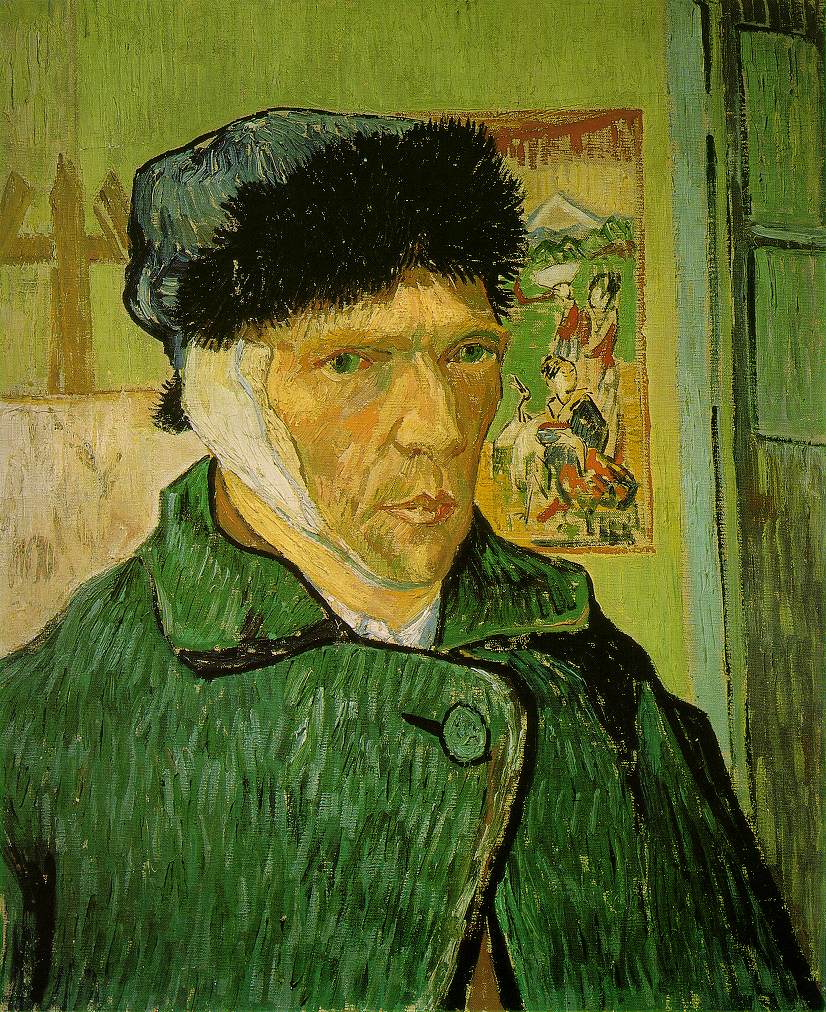
Added 23/4: These are the "originals" in the top drawing clockwise from top left:
http://www.ibiblio.org/wm/paint/auth/gogh/self/gogh.bandaged-ear.jpg
http://arthistory.about.com/od/from_exhibitions/ig/frida_kahlo/Frida-Kahlo---Self-Portrait--1940.htm
http://en.wikipedia.org/wiki/File:Egon_Schiele_079.jpg
http://www.codart.nl/news/89/
http://www.artquotes.net/masters/picasso/pablo_selfport1907.htm
http://en.wikipedia.org/wiki/File:Henri_Rousseau_-_Self-portrait_of_the_Artist_with_a_Lamp.jpg
http://www.nga.gov/education/classroom/self_portraits/act_warhol.shtm
http://www.museum-reproductions.com/cgi-bin/modern.pl?fid=1039954407&cgifunction=form
http://arthistory.about.com/od/from_exhibitions/ig/frida_kahlo/Frida-Kahlo---Self-Portrait--1940.htm
http://en.wikipedia.org/wiki/File:Egon_Schiele_079.jpg

http://www.codart.nl/news/89/
http://www.artquotes.net/masters/picasso/pablo_selfport1907.htm
http://en.wikipedia.org/wiki/File:Henri_Rousseau_-_Self-portrait_of_the_Artist_with_a_Lamp.jpg

http://www.nga.gov/education/classroom/self_portraits/act_warhol.shtm
http://www.museum-reproductions.com/cgi-bin/modern.pl?fid=1039954407&cgifunction=form
Tuesday, April 12, 2011
Subscribe to:
Posts (Atom)